At the Royal Society of Arts
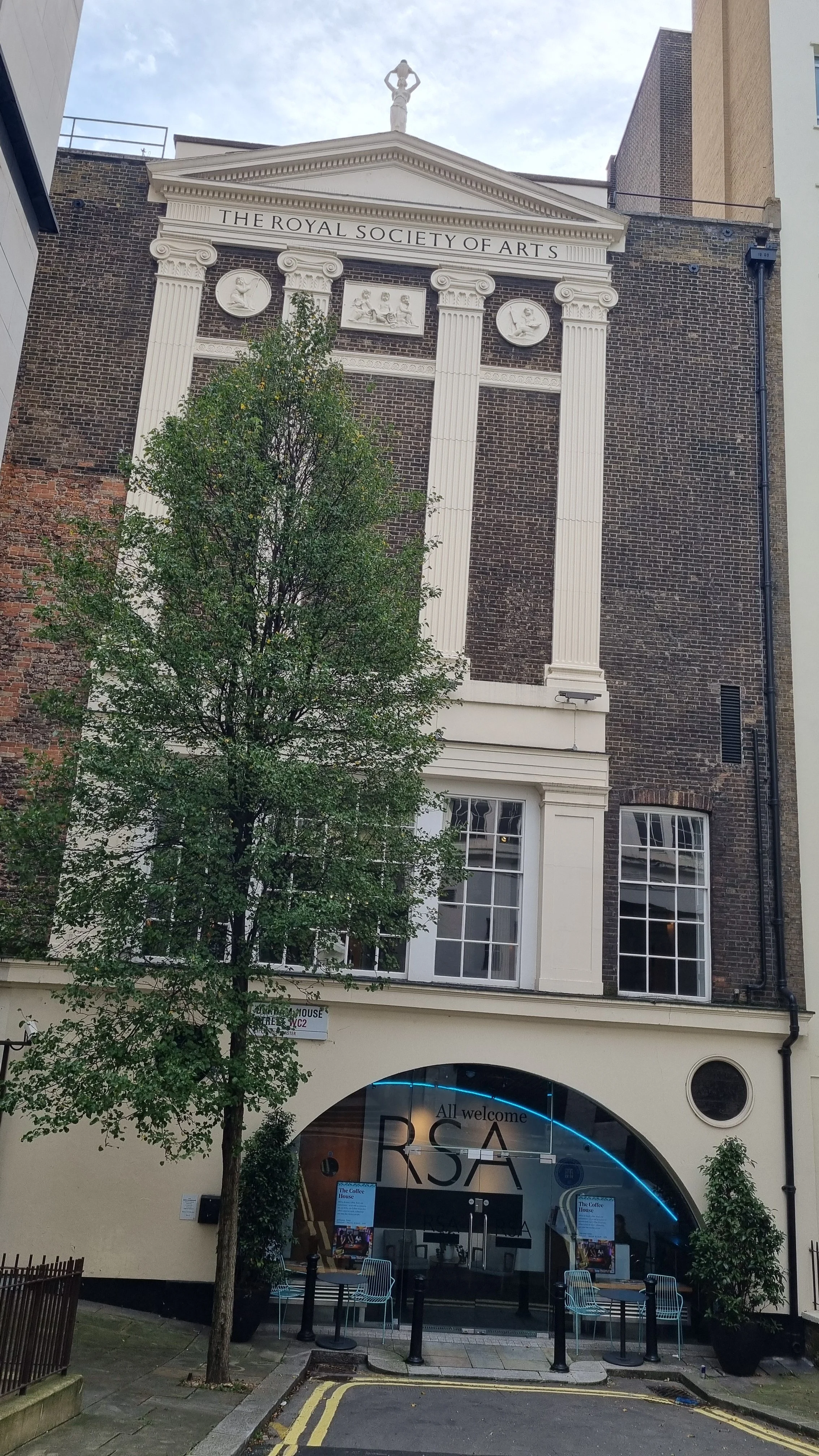
The Royal Society of Arts, London
Recently, I was lucky enough to visit the archive of the Royal Society of Arts, which still flourishes in its eighteenth-century premises just off the Strand! Originally the Society for the Encouragement of Arts, Manufactures and Commerce, the RSA was established in 1754 at the nearby Rawthmells coffeehouse in Covent Garden by founder William Shipley and 10 of his contemporaries. They believed in the power of human ingenuity to change society for the better, and in particular that creativity might serve the common good.
So, what brought me to the RSA? I was looking for information about an eighteenth-century Scottish composer, James Oswald (1710-1769), who spent the majority of his career in London from 1741 until his death in 1769. I knew Oswald was a member of the society in the early 1760s, and had come across one reference which suggested that he had been proposed by none other than Benjamin Franklin!
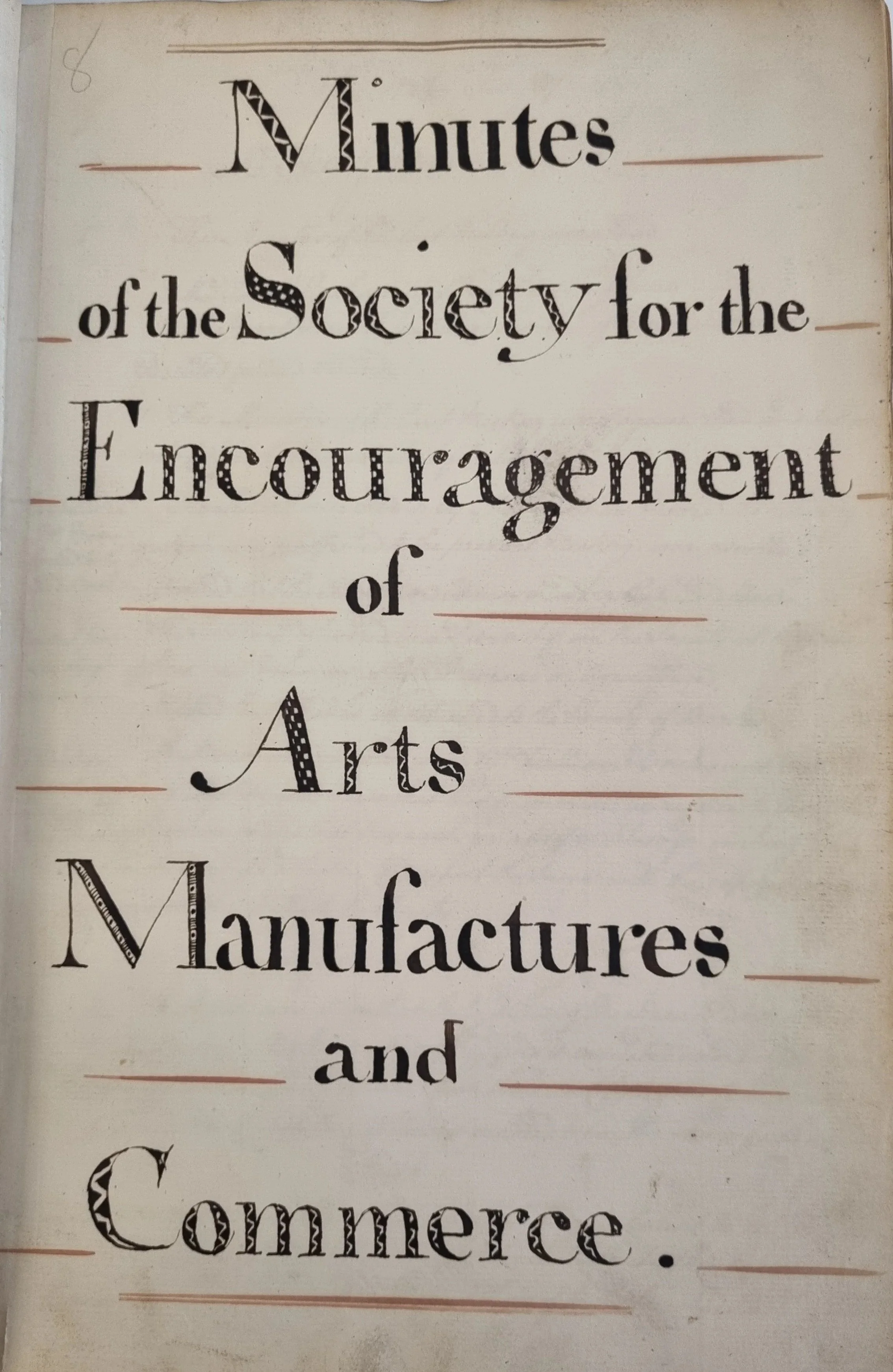
Minute Book of the Society for the Encouragement of Arts Manufactures and Commerce
My first port of call was the first minute book of the society from the earliest days of the society. I love reading through historic minutes of meetings; they can tell you a huge amount about the organisation in question - its aims and priorities at any particular moment; the personalities of those involved and the character of their contribution; disputes, challenges, and much more.
Of course, all this depends on the level of detail included by the clerk or person responsible for taking the meeting notes, but records from this period are often rich in detail, and in this case I was able to confirm that James Oswald was indeed proposed for membership in July 1762 by the American polymath Dr Benjamin Franklin.
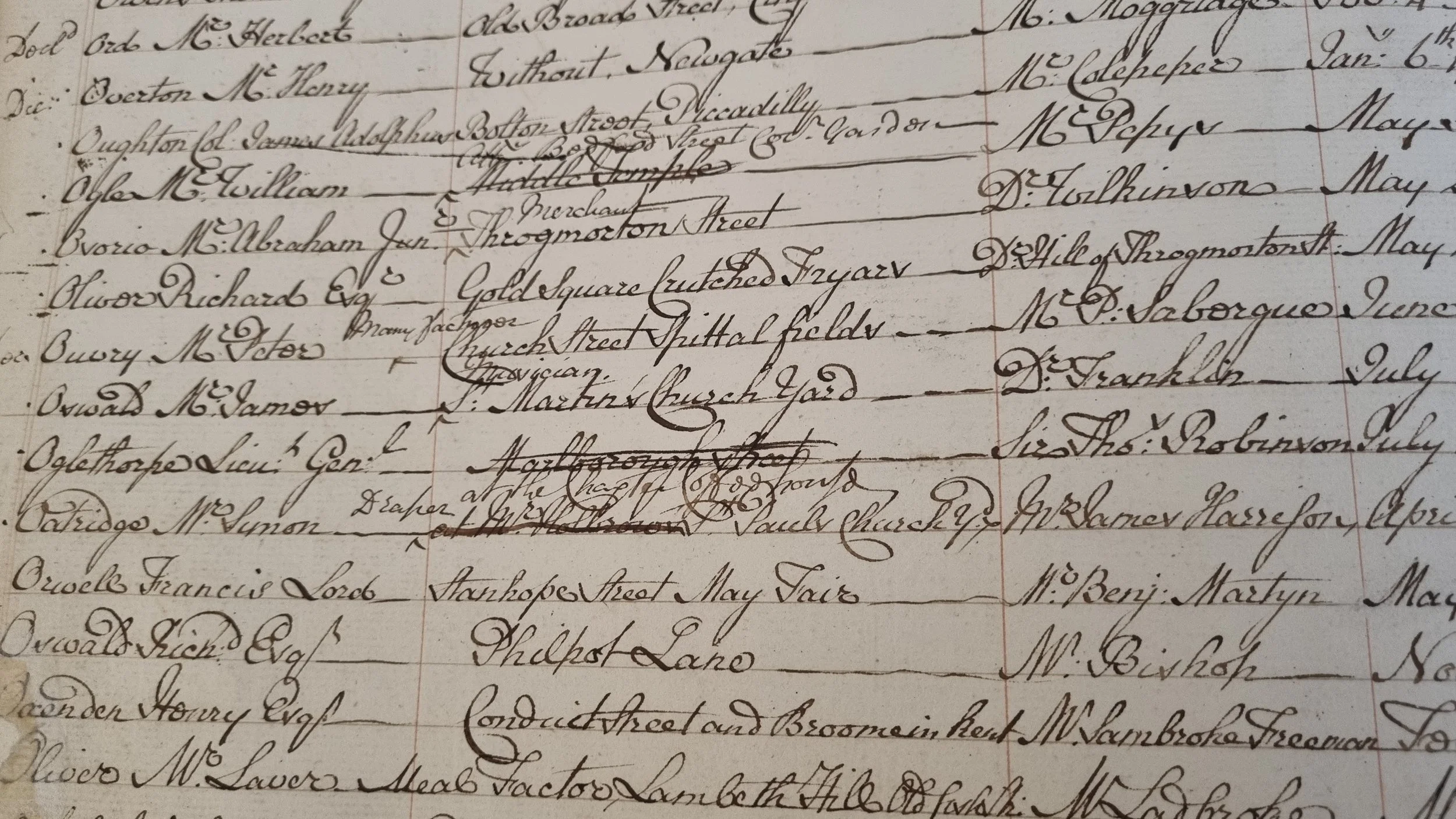
James Oswald’s entry in the RSA’s Membership Subscription Book
Why did James Oswald join the Society? Very few musicians were members - the only others I can identify in the eighteenth century were Thomas Arne and Charles Burney - and most ‘artistic’ members were visual artists. The answer probably lies in Oswald’s existing acquaintance, perhaps friendship, with Benjamin Franklin. Franklin was resident in London from 1757, and he certainly knew of Oswald’s musical performances. In a much-quoted letter of 2 June 1765 to his friend Lord Kames on the subject of Scottish music, Franklin praises Oswald’s interpretation of Scots tunes, without accompaniment: “This support, in my opinion, the old tunes do not need, and are rather confused than aided by it. Whoever has heard James Oswald play them on his violoncello, will be less inclined to dispute this with me.”
We must remember that Covent Garden, and in particular, the area around Charing Cross, was a close-knit community creative endeavour in the mid-eighteenth century. Oswald’s music shop and lodgings on the pavement of St Martin-in-the-Fields were just 4 minutes’ walk away from Franklin’s house in Craven Street. The pair also shared particular interests, particularly musical invention: Oswald ‘reinvented’ the Aeolian Harp in the early 1750s (more on that another day) and Franklin invented the Glass Armonica a few years later. So, we might imagine that it was their shared passion for both music and innovation that drew these two men to the Society for Arts, Manufacture and Commerce.
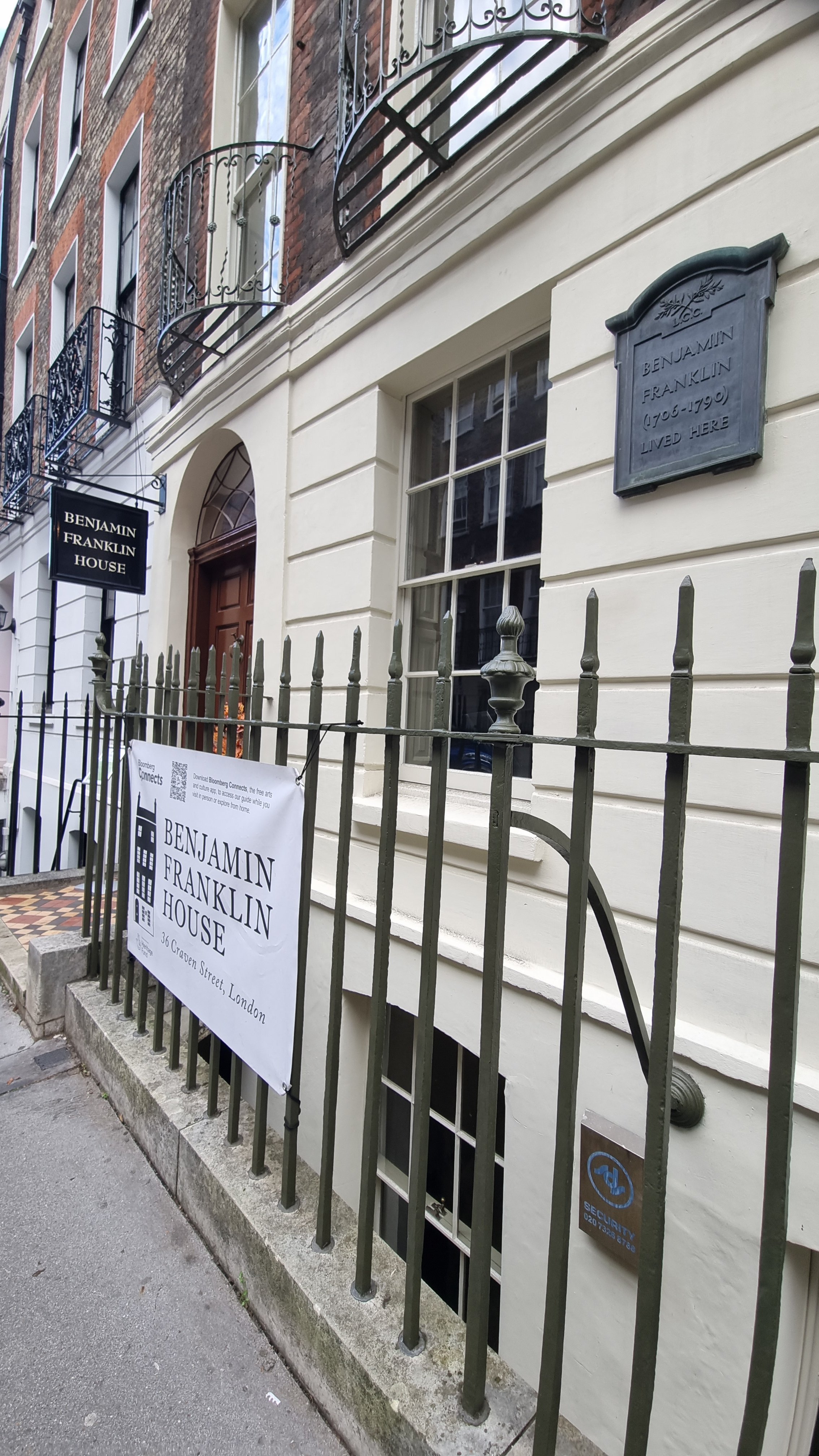
Benjamin Franklin House
After my visit to the RSA, I headed around the corner to Benjamin Franklin House, where Franklin lodged from 1757 to 1775. There are many original features, and, without furnishings, you really get a sense of the character of this Georgian townhouse itself.
Franklin’s rooms were on the first floor, and you can see in the picture on the right his small balconies. A guide told me that Franklin used to rise early, at first light, and invariably stood (naked!) upon the balcony for some minutes to give his skin an ‘air bath’, believing that this practice promoted health and well-being!
If you’re around the Strand with a couple of hours to spare, I would thoroughly recommend a visit to Benjamin Franklin House (entry only £8), before heading round to the RSA. It’s a friendly and welcoming place with a wonderful cafe (open to the public) in the basement, serving fresh, hearty lunches and cakes!

The Musical World of Charles Avison
I’m delighted that my review of Simon Fleming’s The Musical World of Charles Avison has been published in the latest issue of the Journal for Eighteenth Century Studies, the journal of the British Society for Eighteenth-Century Studies.
I so much enjoyed this book, which really captures the world of this under-appreciated Newcastle-based composer. Fleming builds persuasively upon his previous monograph with Martin Perkins, Music by Subscription: Composers and their Networks in the British Music-Publishing Trade, 1676–1820, and subscription lists are employed fascinatingly throughout to bring Avison’s social circle to light.
Here is a short extract from my review:
“The Musical World of Charles Avison is a hugely impressive monograph, in which Fleming undoubtedly achieves his stated objectives, restoring Avison to his rightful place in British music history with a thorough, yet eminently readable, analysis of his works in their widest possible context. This book will be of interest not only to musicologists and practitioners of historically informed performance, but also to any scholar of eighteenth-century British culture, and it is a welcome addition to my bookshelf.”
You can access the full review (institutional access is required) here:
The Musical World of Charles Avison: Melodic Charm and the Powers of Harmony

Coloured for Sight and Sound
I’m so pleased that my review of Stephen Groves’ book, The Sound of the English Picturesque: Georgian Vocal Music, Haydn, and Landscape Aesthetics has been published…
I’m so pleased that my review of Stephen Groves’ book, The Sound of the English Picturesque: Georgian Vocal Music, Haydn, and Landscape Aesthetics has been published in the latest issue of the leading journal Early Music.
I so much enjoyed reading Stephen’s fascinating exploration of the concept of the musical picturesque in late eighteenth-century English song and Haydn’s The Seasons. Here’s an extract from my review:
“The pastoral mode was ubiquitous in the 18th-century English artistic landscape, transporting audiences to a virtuous, idealized Golden Age of shepherds and nymphs, which offered an attractive rural retreat from the complexities of urban life. However, the pastoral’s sister aesthetic, the picturesque, though much applied to art and literature of this period, has rarely been embraced by musicologists. Groves’s The sound of the English picturesque seeks to redress this imbalance, arguing for the strong relevance of the picturesque to English vocal repertoire of the late 18th and early 19th centuries. From the outset, Groves is at pains to demonstrate that the picturesque is qualitatively distinct from the pastoral. For a musical work to express the picturesque, it must venture beyond pastoral convention and instead express, in painterly fashion, the beauty of a particular natural landscape. English composers, Groves suggests, were able to capture the picturesque through musical means, mirroring the techniques of Gainsborough and Capability Brown in their respective arts of landscape painting and gardening.”
To read the full review (though you’ll need an institutional login), just click the link below:
Coloured for sight and sound | Early Music | Oxford Academic

Review: Caledonia to the Capital
I am delighted that my PhD thesis has been reviewed by Jane Pettegree, Lecturer at the University of St Andrews, on Soundyngs…
I am delighted that my PhD thesis has been reviewed by Jane Pettegree, Lecturer at the University of St Andrews, on Soundyngs, a blog which aims to stimulate research into the history of Scottish music. I’m looking forward to giving a concert and accompanying talk at the University of St Andrews in the autumn!
She writes:
“I was particularly struck by the chapters on Robert Bremner, which took this figure comprehensively out of the shadows and into the spotlight as a cultural agent of considerable importance. Chapter 4 significantly extends what we can say about the entrepreneurial role played by Bremner as a cultural advocate of Scottish music on the wider European and Atlantic stage.”
“Currently this research is not a glossy published book, but it deserves to become one, and even in its format as a dissertation it is a lively and useful read.”
To read the whole review, follow this link:

A floral Gramophone Review
My Ensemble Hesperi has received a glowing review from Charlotte Gardner at Gramophone magazine for our latest release, A Gift for your Garden!
My Ensemble Hesperi has received a glowing review from Charlotte Gardner at Gramophone magazine for our latest release, A Gift for your Garden! She writes:
“The young members of award-winning London-based early music Ensemble Hesperi… have brough this carefully considered collection to multicoloured and attractively soft-polished life - think of a playing manner that takes the tack of easy-going, amiably convivial warmth and intimacy rather than super-taut, air-swishing pop, bristle and zing.
Appropriately enough, the Telemann works are particularly happy beneficiaries of this approach: his solo recorder Fantasia No 9 in E, transposed here to calmer G, appears gorgeously dulcetly lyric from Leith, her supremely nimble Vivace included; likewise the first of the ‘Paris’ Sonatas…, where the close-communicating instruments’ sensually poetic voicing and evenly weighted balance produces a showstopper of an Allegro, its radiant exuberance couched within satiny glow; then, while the more madcap virtuosity of his Polish folk-influenced Trio Sonata in G minor (wow, Leith’s rapid Vivace passagework!) comes suitable brighter-hued, there’s still a lovely cantabile nonchalant about the warmth and expressiveness of the strings’ slow-moving, recorder-embellished Largo lines. Such an enjoyable programme. Bravo!”
To read the full review, head to this link:
https://www.gramophone.co.uk/review/a-gift-for-your-garden-telemann-handel-graun-oswald